Whether it is flying gracefully in the sky, running fast on land, or swimming in the water, only one category of animals can do it all – birds. These impressive creatures are natural navigators of the sky, and are quite diverse in their appearances, environments and capabilities. This blog is about some of the remarkable aspects of birds.
Evolution of birds – Dinosaurs shrank and became birds!
Birds evolved from a group of meat-eating dinosaurs called as Theropods (same group to which Tyrannosaurus rex belonged) during the Jurassic age, around 190-150 million years ago! The earliest known birds looked a lot like dinosaurs and had many features in common. They still had sharp teeth in their jaws instead of beaks, and retained a tail. Their wings probably weren’t adapted to flying over long distances. The earliest known bird is widely considered to be Archaeopteryx, which was a small dinosaur equipped with wings to fly. During the late Cretaceous period (around 65 million years ago), the terrifying reign of dinosaurs came to an abrupt end due to a huge asteroid strike, and only four lineages of birds survived that mass extinction event. In the next course of evolution, these lineages evolved in different ways in different habitats, giving rise to ostriches, ducks, fowl and modern birds. Birds are thus direct descendants of dinosaurs.
Flight adaptations
A bird is naturally designed to fly, and every feature of the bird reflects its flying ability. Birds are notably light-bodied and have a streamlined shape to minimize drag. The wings of the bird are designed in such a way so as to provide lift, making it easier for the bird to take off and maintain flight. The wings are curved, which enables air to move more quickly over the top surface of the wing. This reduces air pressure at the top and creates a lift. Birds with larger wings produce greater lift and are able to fly larger distances. Smaller-winged birds need to fly faster in order to create the same lift as birds with larger wings (airplane wings are actually designed after wings of birds). The muscular and skeletal systems of birds are also highly specialized. The bones of birds are hollow and light, unlike the solid bones that we have. Their flight muscles are powerful, and tail feathers are used for steering. Bird lungs work very efficiently to maximize oxygen intake, so that they can fly for long distances without tiring.
Birds of the sea
If you stand on a beach and gaze at the sky, you might probably see a bird gliding peacefully over the waves. Chances are it’s a seabird, which spends a significant portion of its life over the sea. Seabirds have unique features and are different from their cousins, the “land” birds in order to adapt to the marine environment. Seabirds feed in salt water and have a special salt gland near their nasal cavities that enables them to digest the saline water. Seabirds have webbed feet that allow them to swim in the water. The webbed feet also help the birds to propel forward during diving. Seabirds have a lot of feathers compared to other birds, which are waterproof. The dense plumage of these birds thus not only protects them from getting wet, but also shields them from the cold. Seabirds have some of the largest wingspans, and their exceptional eyesight coupled with great flying speeds makes them very good hunters. Often, seabirds live in large colonies.
Flightless birds
You’d think flightless birds would probably be envying their free flying cousins, but these birds are just as marvelous and remarkable. Flightless birds have descended from birds that fly, but for several reasons, they have done away with flight. They are adapted variously to thrive in specialized environments. The penguin, for example, has paddlelike forelimbs to ensure swimming. The feet of the penguin are located much farther back on the body than other birds, enabling it to walk upright. All penguins walk on the soles of their feet rather than the toes, and their lilting walk is really adorable to watch. Other flightless birds are highly specialized for running. The ostrich, emu, rhea and cassowary have long, strong legs for running fast. Cormorant, kiwi, and waterfowl are some of the other popular flightless birds. Flightless birds make up some of the largest and heaviest birds on the planet. The ostrich is the largest and the heaviest bird on the planet, with a height of 2 – 2.5 meters and a weighing around 160 kg. They can run pretty fast at a speed of 65-70 km/h.
Migration – a survival mechanism
Migration is a critical feature in the life cycle of many birds. Migration is an important trait that allows birds to escape harsh climatic zones in favour of pleasant ones. Migration also gives them plentiful access to food, allows mating and enables them to raise their young. Birds have evolved different migration patterns, routes and times to give themselves the greatest chance of survival. Migratory birds can sense the change in the light levels and temperature and know when the timing is right to begin migration. One of the greatest mysteries of migration is how birds find their way accurately from their starting point to their destination, which may be located hundreds or thousands of miles away. In recent years, it has come to light that many birds synthesize special compounds that enable them to sense the Earth’s magnetic field. This is sort of like an internal compass, which allows the birds to orient themselves in the right direction during journeys. Birds also have sharp eyesight and good memory (brainy birds, not bird brains!), which enable them to accurately map geographical features like mountains, rivers, coastlines and deserts. Additionally, some birds rely on star positions and constellations at night to guide them. Once learned, the parents teach the migration patterns to their young ones. Migratory birds coming to India include Siberian cranes, flamingoes, Amur falcon, bar-headed goose, and the black-winged stilt.
One of the most remarkable migratory bird is the Arctic Tern. This is a slender, greyish-white bird with angular wings, and breeds at the Arctic regions. However, during onset of winter, it travels all the way from the Arctic region to Antarctica, where it enjoys the Antarctic summer. The Arctic Tern achieves this stupendous feat by traveling from Greenland to Antarctica through the Atlantic Ocean, a round-trip average distance of 75000 km! This is by far the longest known migration route in the entire animal kingdom. As a result, this bird enjoys two summers in one year.
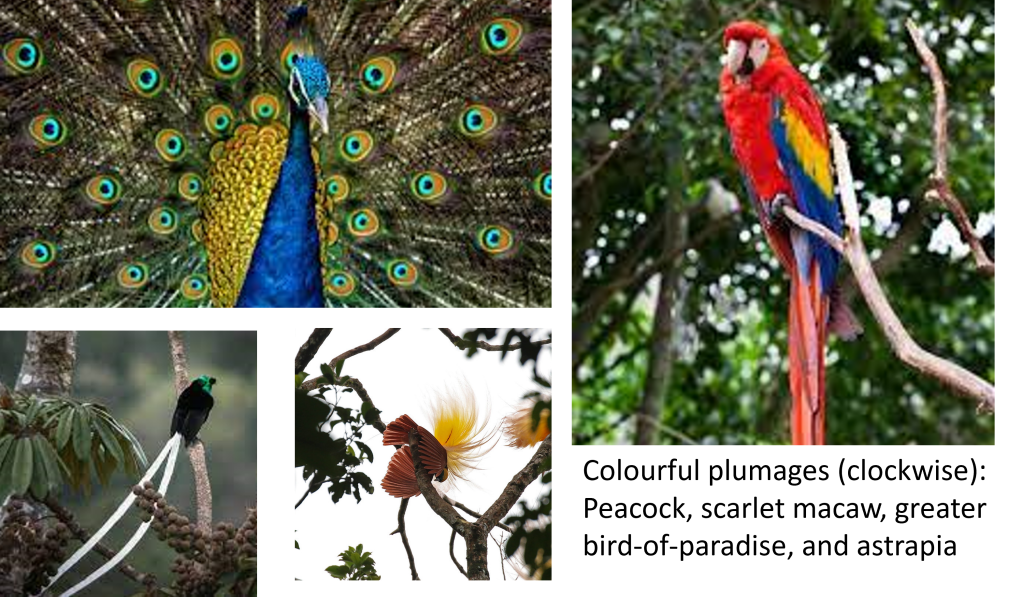
Impressive array of diversity
Birds come in a breath-taking number of shapes, sizes and colours, and some really make an extra effort to stand out from the crowd. Some birds have evolved particularly impressive plumages and tails. Whether long, colourful, or strikingly beautiful, these features help to attract mates. Some birds aren’t really bothered to keep up fashionable appearances but are capable of other astonishing feats. The peregrine falcon is a powerful, sharp-winged raptor and is the fastest known animal on the planet. Renowned for its speed, this bird can attain speeds of 330 km/h while diving. With its sharp talons and jaw-dropping speed, this bird is a highly efficient hunter, and the prey usually has no chance to survive its onslaught. Whether it is making record-setting flights, building fantastic nests, growing spectacular plumages or singing impressive vocals, birds always find ways to astonish and amaze us.


Very well written with a clear explanation of birds and their evolution. Expecting another article to explain what made dianosours fly, when they were strongest and getting everything in land.
LikeLike
https://ncaa-tournament.si.com/2025/08/22/bangladesh-casino-scene-where-to-play-cash-out-not-get-burned/
LikeLike