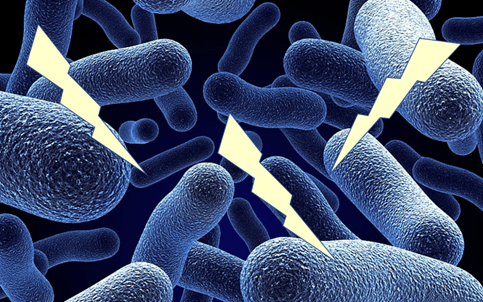
When we think of electricity, some of the first things that come to our mind are lightning, glowing electric bulbs and power plants. We have designed several useful applications that run on electric power. Our homes, appliances, gadgets and vehicles are all powered by electricity, and it is difficult to imagine a world where we can live without electricity. Apart from generating electricity from coal, water, solar and wind, electricity can also be generated by bacteria! We humans are not the only ones that harness the power of electricity; in fact, some bacteria are very efficient at generating electricity from their metabolic activities. So how do bacteria produce electricity, and how can it be useful?
Bioelectricity
All respiratory activities in living organisms involve electrochemistry, i.e. the transfer of electrons from one chemical species to other. When food is consumed, it is broken down into smaller units during digestion, and the electrons that are generated during this process are finally transferred to oxygen to generate energy. That is why oxygen is such a vital element for life as it enables energy generation via respiration. However, there are several environments where oxygen is absent (anaerobic environments). In order to survive in these environments, bacteria use other alternatives to oxygen for their respiratory activities. Some anaerobic bacteria use minerals containing iron and manganese to transfer electrons generated during metabolism. This phenomenon is known as extracellular electron transfer, where electrons generated during metabolism are transferred outside the bacterial cell to an external acceptor. In order to transfer electrons, bacteria use specialized mechanisms. Some bacteria possess electric wires (termed nanowires), which can facilitate electron transfer. Other bacteria use proteins on their outer membranes to transfer electrons. Electrons can also be shuttled outside via the use of chemicals, which are produced by the bacteria themselves. Bacteria capable of extracellular electron transfer are known as “electrogens”. The field of bioelectrochemistry thus studies the electrochemical functionalities of microbes that enable them to generate current.
The phenomenon of extracellular electron transfer is what is exploited to generate electricity from bacteria. Devices that use electrogenic bacteria to generate current are known as bioelectrochemical systems. Microbial fuel cells, microbial three-electrode cells and microbial electrosynthesis cells are all different types of bioelectrochemical systems. In these devices, electrogenic bacteria are maintained in anaerobic conditions in the presence of a solid conducting electrode. When nutrients are provided to the bacteria, electrons are generated upon their breakdown, which are transferred to the electrode to generate current. Two of the most important electrogens capable of generating current efficiently are Shewanella and Geobacter. My research work involves the field of bioelectrochemistry, where I use electrochemically-active bacteria in bioelectrochemical reactors for various applications.
Useful applications of bioelectrochemical devices
Though the quantum of current generated by bioelectrochemical systems is much smaller compared to other energy sources, these devices offer several important applications. If wastewater is used in these systems, bacteria are capable of using the wastes as a food source, and break them down to generate current. Thus, dual objectives of wastewater treatment and energy generation can be achieved. Some companies have successfully combined bioelectrochemical systems with water treatment plants to generate electricity from wastewater. The power generated reduced the operational costs.
In certain places like Ghana and India, this technology was used to create a self-sustaining bioelectric toilet. Biodegradable matter present in urine and faecal matter was converted to electricity, which was used to light up a small light source inside the toilet. The wastes were treated efficiently in this process. Recently, researchers in England were able to combine several stacks of microbial fuel cells running on urine to charge up a mobile phone!
This technology is also capable of recovering heavy metals from polluted waters. Industrial effluents that are discharged into the environment often contain heavy metals like copper, chromium and lead, which pose several hazards. These effluents containing heavy metals can be used in microbial fuel cells to recover heavy metals from the water along with simultaneous generation of power. The recovered heavy metals can be reused elsewhere, and the effluents become free of metal contamination before discharge.
Bioelectrochemical systems can also be used as biosensors which give an indication of water quality. Since electricity generation is dependent on organic wastes present in the water sample, the electric signal generated from these devices can directly be correlated to the amount of wastes present in the sample.
Microbial fuel cells are also being used in space shuttles to generate renewable energy from wastes. Apart from this, several marine buoys that are deployed in the deep sea as probes are also powered by microbial fuel cells.
One of the most interesting applications of these devices relates to carbon capture from the environment. It has been discovered that bacteria like Shewanella can also accept electrons from an external source. If electrons from carbon dioxide are stripped and passed on to Shewanella, several useful chemicals and fuels can be synthesised. And since carbon dioxide is a greenhouse gas, generating useful products while reducing its levels serves as a win-win situation.
Bioelectrochemistry for sustainable energy generation
In recent times, new mechanisms of extracellular electron transfer have been discovered. Scientists have also discovered electrogenic bacteria in several environments – deep sea, river sediments, soils, marshes and even the human gut! Yes, that’s right – gut bacteria in our stomach can generate electricity, and while we may not have butterflies in our stomach, we can certainly generate electric sparks! Since this technology is clean, relatively cheap and self-sustaining, a lot of research is actively being carried out to improve the power output from these devices and to expand the scope of applications. Scaling up of this technology holds great promise, as it reduces dependence on fossil fuels and paves way for sustainable generation of clean power.
 Discover Science
Interesting !!
I did not know so kuch about it before u hv explained it in easy language !!
👍
LikeLiked by 1 person
Transition metal redox shuttle in microbial world has been beautifully captured in words!
Interesting to note your work on bio-electrochemical systems.
Best wishes
Dr. Sai
Renault Nissan Technology & Business Center, India.
LikeLiked by 1 person