A darkly mysterious world lies below the surface of the sea. It is estimated that more than 60% of the Earth’s surface is covered by ocean water more than a mile deep. The deep sea is the single largest habitat on earth and is widely unexplored. In fact, it is speculated that more is known about the moon’s surface than the deep sea.
The deep sea is an extreme environment. Oxygen levels fall steeply as depth increases. The water pressure too increases tremendously with depth. For every 10 metres, the pressure increases by 1 atmosphere (the pressure we face on land). Thus, organisms living deep in the sea have to cope with a massive crushing force of several hundred atmospheres, not to mention the inherent salinity of the water. The temperature of the water ranges from -1°C to 4°C. Moreover, light penetration too decreases progressively, and there is virtually no light beyond a point (250-300m), making it a frigid, intense, black expanse of water (https://www.youtube.com/watch?v=_-m7KwVlIQY).
However, life has found a way to survive even in such a desolate and extreme environment. Animals belonging to the deep sea exhibit marvellous adaptations that enables them to survive on limited resources. Certain fishes like the blacksmelt stout have giant eyes that enable them to capture the faintest traces of light, giving them an advantage over other fishes. Many fishes naturally have chosen to abandon vision altogether, instead relying on vibrations and touch to sense prey. These fishes have elongated fins that allows them to do this. Certain fishes resort to bioluminescence to generate light of their own. Fishes such as lantern fish and the anglerfish generate light that attracts prey towards themselves. This is also a nice strategy to attract mates. There also appear to be certain “stick-like” organisms with tentacles around them, all oriented in the same direction. These are sea cucumbers, possibly oriented similar to capture food effectively.
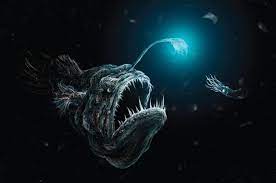
The bioluminescent anglerfish attracting prey
The scarcity of food has given way to some interesting phenomena. On land, trees generate food from sunlight and support the food chain, but there is no such provision in the sea due to lack of light. So the deep sea organisms survive on dead animals sinking to the bottom of the sea, a phenomenon called as “marine snow” (You can watch it here: https://www.youtube.com/watch?v=Fo2J9kDQkKA&t=47s). In case the massive carcass of a whale makes its way below, it serves as a rich treat for the entire ecosystem below, sustaining the organisms for several months. Apart from the flesh, even the bones of the whale are completely consumed by organisms like the boneworms, eventually leaving no trace of the body!
Since the pressure of water in the deep sea is enormous (around eight tons per square inch!), and the temperature is near to freezing point, the animals need special adaptations to survive these conditions. The bodies of the animals are highly streamlined in order to minimise fluid resistance as they travel through the water. All the cells of the organisms are covered by a membrane containing fats, which insulates them against the cold. The cells also accumulate certain structures called “piezolytes”, which protect the proteins from getting denatured. The piezolytes are the ones responsible for the typical “fishy” smell.
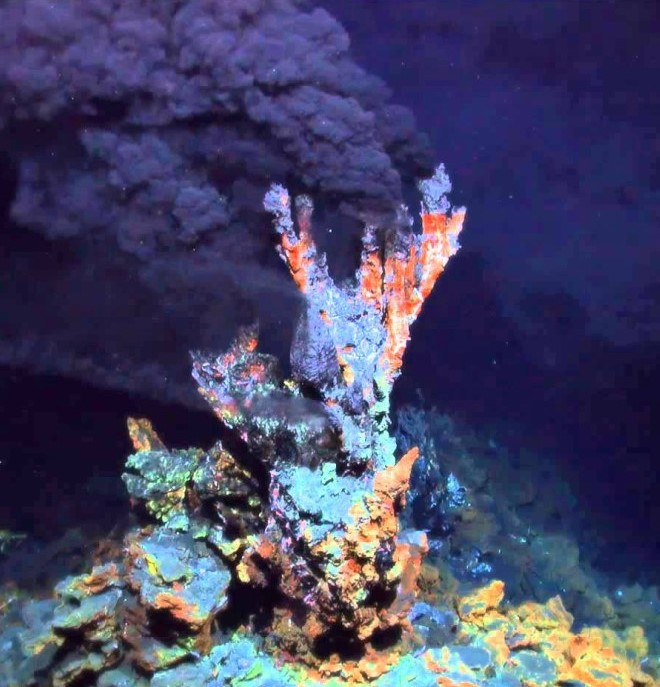
A hydrothermal vent in the deep sea
Some of the most extreme conditions, however, are encountered in deep sea hydrothermal vents. These vents are located in volcanically active areas in the sea’s surface. As seawater rushes through the fissures into the hot magma, it heats up and absorbs a lot of chemicals. As this hot water rises above, it reacts with the cooler water around it, giving rise to chemical deposits that over a period of time form solid towers or vents. The temperature of the hot water is around 450°C, hot enough to melt lead. Most astonishingly, life is found even at these vents! Certain bacteria use the minerals and gases like carbon dioxide and methane in these vents as energy sources, converting them into sugars by respiration. Such deep sea zones are thought to be among the places that first gave birth to life on earth. In fact, a lot of research is being done on how life adapts to these extreme conditions. Such places also give a hint on whether life could be found on other planets with similar conditions.


A fascinating account of the deep Sea.
LikeLike
Quite interesting and amazing. A good account of the deep sea world.
LikeLike